Implant-free breast aesthetics can reshape and lift the breast using a patient’s own tissue, offering another route to natural-looking fullness.
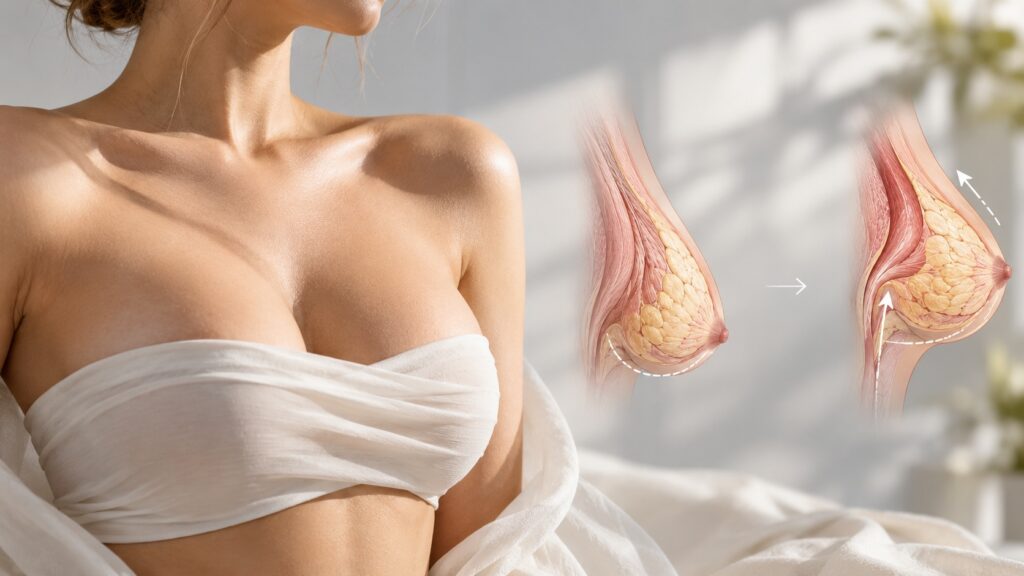
For years, conversations about breast aesthetics have tended to circle around a familiar set of options: lift the breast, add an implant, or combine the two. There is another possibility, though. In selected patients, the breast tissue that is already present can be repositioned and used to create volume, support and a more balanced contour.
This approach is particularly relevant for women who have enough natural breast tissue but have experienced sagging, loss of upper-pole fullness or changes after pregnancy, breastfeeding, ageing or weight fluctuation. In these cases, the question does not always have to be “How much volume should be added?” Sometimes it makes more sense to ask: how effectively can the existing tissue be used?
How Can Breast Aesthetics Be Performed Without Implants?
Implant-free breast surgery works with a patient’s existing tissue rather than introducing a silicone implant. Depending on the anatomy and technique, breast tissue can be lifted, reshaped and repositioned to improve projection or restore fullness where it has been lost.
This overlaps with concepts such as mastopexy, autoaugmentation and autologous tissue reshaping. These are not necessarily the same operation. What they share is a basic principle: the patient’s own tissue plays an active part in creating the new breast shape.
A traditional breast lift, for example, mainly addresses ptosis, or sagging. The breast and nipple are repositioned and excess skin may be removed where necessary. Autoaugmentation techniques take a different step by using existing breast tissue strategically to contribute to shape and volume.
Why Is Upper-Pole Fullness Important?
The upper pole is the part of the breast above the nipple. As breast tissue descends over time, this area can begin to look relatively empty even when the breast still has adequate overall volume. It explains why some women describe the change as “deflation” rather than simply a reduction in breast size.
An implant can create upper-pole volume, but it is not the only surgical way to approach the problem. With suitable anatomy, natural breast tissue may be redistributed upward instead. The harder part is not simply moving that tissue. It also needs appropriate internal support if the intended contour is to be maintained.
What Is Autoprosthesis?
An autoprosthesis is created from the patient’s own tissue and used as an internal source of volume and support. In aesthetic breast surgery, you can think of it as using available breast tissue for biological autoaugmentation rather than introducing a manufactured implant.
There is no single way to do this. Some surgical approaches reshape or fold glandular tissue; others reposition it into another anatomical plane. How much usable tissue a patient has, its quality, the degree of breast ptosis, skin characteristics and the desired result all affect whether an autoprosthesis approach is appropriate.
One contemporary example is Autoprosthesis based on a dual-plane principle. Here, tissue from the lower part of the breast is prepared while preserving its biological connection, then repositioned into the subpectoral plane. The pectoralis major muscle contributes to the internal support of that tissue.
How Can Your Own Tissue Create Internal Support?
Breast shape depends on more than the amount of tissue present. Where that tissue sits matters just as much. A patient may have adequate breast volume overall, yet still have limited fullness in the upper part of the breast.
Autologous breast reshaping tries to make better use of that existing volume. Instead of treating useful lower-pole tissue simply as excess during a lift, certain techniques preserve it and move it to another position. That tissue can then contribute to projection and upper-pole fullness while the rest of the breast is reshaped around it.
Does Autoprosthesis Mean Fat Transfer?
No, not necessarily. The two are easy to confuse because both involve the patient’s own tissue.
Fat transfer usually means taking fat from another part of the body, processing it and injecting it into the breast. An autoprosthesis technique can instead use vascularised breast tissue that remains connected to its blood supply and is surgically repositioned. The source of the tissue and the way it is used are therefore quite different.
Implant-Free Breast Aesthetics vs Breast Implants
There is no useful universal answer to the question of which approach is “better.” They do different things, and patients do not begin with identical anatomy or expectations.
| Consideration | Own-Tissue Approach | Breast Implant |
|---|---|---|
| Source of volume | Existing autologous tissue | Manufactured implant |
| Foreign material | May be performed without an implant | Silicone or saline implant is placed |
| Available volume | Limited by existing anatomy and tissue | Implant size provides additional volume |
| Shape planning | Strongly influenced by tissue distribution and quality | Implant dimensions contribute to volume and projection |
| Patient suitability | Requires sufficient appropriate tissue for the planned technique | Depends on anatomy, goals and clinical assessment |
Consider two patients who both want a fuller-looking breast. One wants a substantial increase in size. The other already has enough volume but wants the breast lifted and that volume redistributed toward the upper pole. Their goals sound similar at first, but the surgical requirements may be very different.
That is why reducing the decision to “implant or no implant?” does not tell the whole story.
How Does Dual-Plane Autoprosthesis Work?
Dual-Plane Autoprosthesis uses two anatomical planes to create and support an internal volume unit from the patient’s own breast tissue. The inferior dermoglandular pedicle is mobilised and positioned in the subpectoral plane while its vascularity is preserved.
There is an important technical distinction here. The tissue is not simply folded within the same breast plane. The prepared tissue is moved beneath the pectoralis major, combining autologous volume with support from the muscle.
Repositioning Lower-Pole Tissue
With breast ptosis, a considerable portion of the existing volume may sit lower on the chest. During suitable mastopexy planning, some of this tissue can potentially be preserved and used rather than viewed merely as tissue that needs to be removed.
The dermoglandular tissue is shaped according to the patient’s anatomy and moved toward the area where more projection or fullness is wanted. With a dual-plane technique, it is placed in a pocket beneath the pectoral muscle and secured internally.
The Role of Pectoral Muscle Support
The pectoralis major does not create extra breast volume. That volume still comes from the patient’s own tissue. The muscle has a structural role: placing the autoprosthesis in the subpectoral plane gives the repositioned tissue another anatomical layer of support.
This is what separates the concept from simple glandular folding. The aim is to create an internally supported autologous volume unit, while the remaining breast tissue and skin envelope are reshaped to form the final contour.
PureOwn and the Dual-Plane Autoprosthesis Approach
The concept has been developed into a specific surgical technique by Op. Dr. Umut Zereyak. pureown focuses on the Zereyak Autoprosthesis approach, where an inferior dermoglandular pedicle is transferred to the subpectoral plane to create upper-pole volume from the patient’s own breast tissue.
The technique has also been described beyond a purely promotional setting. It was reported in the peer-reviewed journal Aesthetic Plastic Surgery in 2026 as the “Dual Plane Autoprosthesis Technique”, with clinical outcomes evaluated in a 47-patient series. For anyone researching a relatively new surgical method, this matters: a published technique can be examined and discussed within the medical community rather than assessed only through marketing material.
That does not mean publication makes an operation suitable for every patient. The available clinical evidence concerns a defined patient group and follow-up period. Larger studies and longer follow-up remain useful for understanding how outcomes develop across different patients over time.
Who May Be a Candidate for Implant-Free Breast Reshaping?
Anatomy is a major part of the answer. Own-tissue autoaugmentation is generally more relevant when a patient already has enough breast tissue to redistribute and her aesthetic goals can realistically be achieved without adding an implant.
Potential candidates may include women with:
- moderate or more pronounced breast ptosis;
- adequate natural breast tissue;
- loss of upper-pole fullness after pregnancy or weight change;
- a preference to avoid silicone implants or other foreign materials;
- existing breast volume that is concentrated in less desirable areas;
- realistic expectations about the amount of shape and volume their own tissue can provide.
The final point is especially practical. Your own tissue is a finite resource. An implant introduces additional volume in a selected size and profile; an autologous technique has to work with what your anatomy already provides. The result you want therefore matters just as much as the name of the procedure.
What Does “Noimplant” Actually Mean?
Noimplant breast aesthetics broadly describes attempts to achieve the intended aesthetic change without placing a conventional breast implant. It is not the name of one universal operation.
Mastopexy, tissue autoaugmentation, certain autoprosthesis techniques and fat grafting can all come up when researching implant-free options, although they do not work in the same way. Looking beyond the label is useful. What tissue will be used? Where will it be positioned? What will support it? What scars are expected, and how much volume change is actually realistic?
For those researching the specific use of existing breast tissue as an internally supported source of upper-pole volume, Implant-Free Breast Aesthetics offers a detailed example of how this concept is applied through Dual-Plane Autoprosthesis.
What Should You Consider Before Choosing an Implant-Free Technique?
Start with the result you want rather than the name of a procedure. “Natural-looking breasts” can mean very different things to different people. Size, cleavage, projection and upper-pole fullness may each carry a different priority.
A useful consultation should look at several factors:
- the amount and distribution of existing breast tissue;
- the degree of ptosis;
- skin quality and elasticity;
- breast asymmetry;
- previous breast surgery;
- the desired increase or reduction in apparent volume;
- expected scars and recovery;
- the limitations and risks of the proposed operation.
It is worth asking very directly what a proposed technique can and cannot achieve with your anatomy. Before-and-after photographs may help, especially when they show patients with a similar starting point, but they cannot promise that another patient will get the same result.
Are Implant-Free Procedures Risk-Free?
No. Avoiding an implant may remove implant-specific issues from the equation, but it does not remove the general risks associated with breast surgery.
Depending on the operation, these can include bleeding, infection, wound-healing problems, scarring, asymmetry, changes in sensation, tissue-healing issues and the possibility of revision surgery. Smoking, medical history, tissue quality and the extent of the operation can also affect an individual’s risk profile.
In other words, “natural” should not be read as “minor” or “risk-free.” Using your own tissue may be appealing for several reasons, but it is still surgery and should be assessed with the same care as any other operative option.
Natural Breast Aesthetics Is Ultimately About Patient Selection
Interest in autologous breast surgery reflects a fairly simple idea: creating a new shape does not always require adding new material. Sometimes useful volume is already present; it is simply sitting in a different part of the breast.
For the right patient, redistributing that tissue may provide an alternative to conventional augmentation. Someone else may be better suited to an implant, fat transfer, a standard mastopexy or another combination. There is no sensible one-size-fits-all answer.
If implant-free surgery interests you, look closely at how the proposed technique uses your anatomy, review the evidence available for it and discuss your expectations with a qualified plastic surgeon. Ultimately, an individual examination is what determines whether an own-tissue approach is technically appropriate.
Frequently Asked Questions
Can breasts be lifted without implants?
Yes. A mastopexy can lift and reshape the breast without an implant. Whether it can also create the degree of upper-pole fullness you want depends on your existing tissue, anatomy and the technique used.
What is an autoprosthesis in breast surgery?
An autoprosthesis uses the patient’s own tissue to create internal volume or support. In breast surgery, existing glandular and fatty tissue can be reshaped or repositioned rather than relying on a manufactured implant.
Is an autoprosthesis the same as a silicone implant?
No. A silicone implant is a manufactured device placed in the breast. An autoprosthesis is formed from the patient’s own biological tissue.
Is autoprosthesis the same as fat transfer?
No. Fat transfer usually involves taking fat from another part of the body and injecting it into the breast. Autoprosthesis techniques can instead use existing vascularised breast tissue that remains connected to its blood supply while being surgically repositioned.
Can upper-pole fullness be created without implants?
Yes, in selected patients it may be possible. Autoaugmentation and autoprosthesis techniques can move existing tissue toward the upper breast, but the amount of fullness that can be created is limited by the patient’s anatomy and available tissue.
Who is most likely to be suitable for an own-tissue approach?
Someone with sufficient breast tissue, breast ptosis and a goal focused on reshaping rather than a large increase in volume may be a potential candidate. A surgical assessment is still needed to determine suitability.
Can implant-free surgery significantly increase breast size?
The increase is limited by the amount of tissue already available. If the goal is a substantial increase in breast volume, other options may need to be discussed with the surgeon.
Does implant-free breast surgery leave scars?
It can. If the procedure includes mastopexy, incisions are needed to reshape the breast and its skin envelope. The eventual scar pattern depends on the degree of lift and the surgical plan.
What causes breast ptosis?
Ageing, pregnancy, breastfeeding-related changes, weight fluctuations, skin elasticity, breast volume and genetics can all contribute to sagging. In practice, there is often more than one factor involved.
Are results from own-tissue breast reshaping permanent?
No surgical result is immune to future change. Ageing continues, and gravity, pregnancy, weight fluctuations and changes in tissue quality can alter breast shape over time.
Does avoiding implants eliminate all complications?
No. It removes complications that specifically depend on an implant being present, but general surgical risks still remain. Those risks should be discussed individually with a qualified surgeon.
How should I compare implant and implant-free breast surgery?
Compare them according to your anatomy and what you actually want to achieve. Existing tissue, desired volume, degree of sagging, scars, recovery, possible complications and long-term expectations all belong in that discussion; neither approach is automatically the right one for every patient.
What is your reaction?
 I liked it
 Wonderful
 Thanks
 Good
Good Hahaha !
 Incredible
 Interesting
 Wrong
Wrong